Adapted from an article originally published on April 2, 2024 in the Santa Clara Business Law Chronicle.
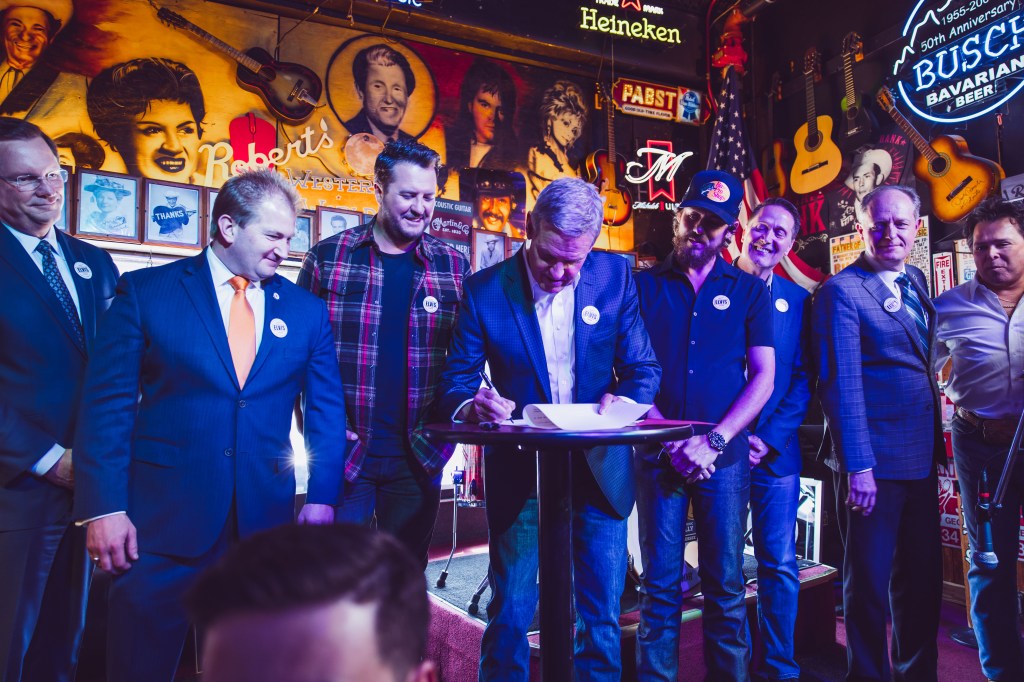
On March 21, 2024, Tennessee became the first state to enact legislation aiming to protect likeness, voice, and image rights from generative AI. Tennessee Governor Bill Lee signed into law these protections with the Ensuring Likeness Voice and Image Security Act, or the ELVIS Act.
As a center for the American music industry, it’s only fitting that Tennessee be the first state to sign into law legislation that covers the intersection of music and AI. However, the ELVIS Act has faced strong criticism for missing the mark by being overbroad and not properly tailored to the legislature’s goals.
What is the ELVIS Act?
People are able to use modern AI to mimic popular artists singing different songs, and it can prove difficult to determine what songs are real and what are AI-generated. AI has also been used to create ads depicting celebrities endorsing products without the celebrity even knowing about them. These deepfakes can be concerning, and Tennessee’s new law understandably comes from a fear of AI’s ability to replicate a celebrity’s likeness.
The ELVIS Act aims to crack down on this type of AI content by expanding Tennessee’s former publicity rights law, the Personal Rights Protection Act of 1984. The 1984 Act provided typical publicity rights protections, which protect celebrities from the unauthorized use of their name, photograph, and likeness for commercial purposes. Publicity rights are designed to prevent action such as using a celebrity’s likeness in an advertisement they did not agree to be involved in, like in White v. Samsung Electronics America, Inc., where Vanna White, the famous Wheel of Fortune hostess, sued the electronics giant for running an ad featuring a robot dressed like her.
Publicity rights differ from state to state, but some are used to protect musical artists from copying. In 1988, Bette Midler, a famous 1970s singer and actress, sued Ford for using a sound-a-like artist performing a cover of Midler’s, “Do You Want To Dance”, in a commercial. Ford had approached Midler to sing one of her hits for a car commercial, but Midler declined. Rather than omitting the song from the commercial, Ford decided to proceed by hiring a voice impersonator to mimic Midler’s singing and used the audio in the commercial. Midler sued, arguing that her voice is covered by publicity rights as part of her “likeness”. The Ninth Circuit agreed with her, ruling that her voice was distinctive enough to count under her publicity rights.
Although publicity rights in some states can cover voice imitations under some circumstances, Tennessee’s 1984 Act was not written to do so. With the ELVIS Act, the state legislature expanded the 1984 Act to include voice as a “covered depiction” of a person that requires authorization in addition to name, photograph, and likeness. But this is not the only expansion that the ELVIS Act makes.
The 1984 Act imposed liability for using a person’s likeness to advertise or fundraise without that person’s consent. It specifies that there must be some monetary incentive or gain from the use. The ELVIS Act takes this considerably further, adding two additional scenarios to impose liability.
First, the ELVIS Act imposes additional liability for knowingly making public an unauthorized “covered depiction”, regardless of whether it was used commercially. This would cover simply posting something that counts as a covered depiction online as long as it has not been authorized, which could extend to content that followers of an artist produce simply to share with other fans within the community, which has been a common form of expression for young adults for decades.
Second, the statute also imposes liability for anyone offering any kind of technology for the main purpose of creating this type of content, and this, too, does not have to be offered for any sort of commercial use. The categories covered by this technology are extremely broad, as well. The statute covers any “algorithm, software, tool, or other technology, service, or device” with the primary purpose of producing covered depictions without authorization. Because this is new legislation, there are not yet cases to determine what falls into these categories. However, the list leaves a significant amount of room for interpretation.
The ELVIS Act’s sweeping definition catches many unintended use cases
The Tennessee legislature had the best of intentions by trying to use the ELVIS Act to protect musicians from having their sound copied and imitated, but the statute does more harm than good by sweeping in vast amounts of positive uses for AI technology along with the few nefarious ones.
The Act is intended to target the imitation of a singer’s voice for unauthorized purposes. A singer’s voice is arguably their most valuable asset, so it’s clear to see why the Tennessee legislators are so keen to protect it. But it was not wholly without protection in the first place. Midler’s verdict against Ford proves that a singer’s voice can be protected in some circumstances, and while it was not the broadest of verdicts, it still provides a strong starting point for a legislature that wants to expand those protections. The statute did not have to be so sweeping in order to meet their goal.
Instead, many positive and creative uses of technology will be made tortious come July when the ELVIS Act goes into effect. The Act will cover musical artists’ passionate fans that create content out of their admiration for the artist. It will cover teachers that use AI technology to make engaging content for their students that incorporates famous artists popular amongst their students. Apps that fans can use to make themselves sound like their favorite artist and share clips with their friends could not be offered online, even for free.
The ELVIS Act stifles this creative content by generating a fear of litigation, stopping creative works from being made in the first place out of concern the creator may face liability for sharing their works. The statute’s broad language does not provide the clear exceptions and limits that typically end cap the scope of these laws. The statute does not provide limits that protect typical fair use cases like parody or education, nor does it limit liability to actions within Tennessee.
The Tennessee legislature intended to protect the expression and creativity of musical artists, but does so by stifling the expression and creativity of those that support and admire them.


Leave a Reply